
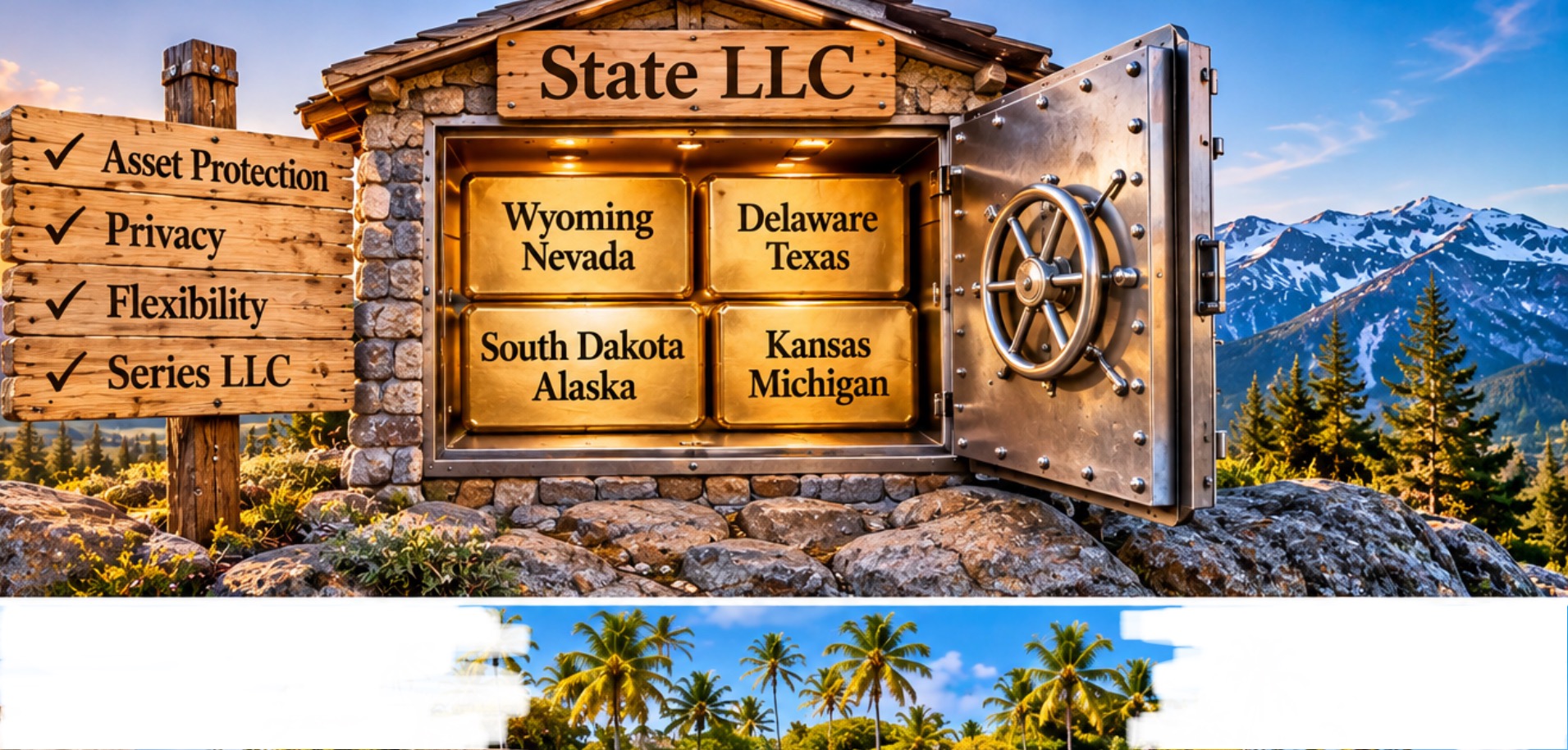
The following matrix compares different U.S. State LLCs and their advantages. Before you choose your best option, contact us, and we’ll guide you through the process.
| State | Distinguishing Feature |
| Wyoming | Exclusive charging-order remedy; expressly addresses single-member LLCs; bars foreclosure and certain other creditor remedies. |
| Nevada | Expressly makes charging order the exclusive remedy for single- and multi-member LLCs; bars foreclosure and other specified remedies. |
| Alaska | Strong statutory charging-order protection, including single-member LLCs. |
| Delaware | Exclusive charging-order remedy; strong contractual flexibility; no foreclosure of the membership interest. |
| Texas | Express single- and multi-member charging-order protection under its amended statute. |
| South Dakota | Strong charging-order provisions and express single-member protections. |
| Kansas | Particularly noteworthy charging-order protections, including single-member treatment. |
| Michigan | Strong statutory treatment of charging orders and creditor remedies. |
These are the states I would put on the initial research shortlist for asset-protection-oriented LLCs. The comparative statutory research supports these distinctions, although the precise protections and exceptions are not identical.
States With Distinct Privacy Advantages
Privacy should be evaluated by examining what the Secretary of State makes publicly searchable, not simply whether the state advertises an LLC as private.
| State | Distinguishing Feature |
| New Mexico | No annual LLC report; member names generally need not appear in public formation records. |
| Wyoming | Member identities generally need not be disclosed in ordinary public formation filings. |
| Delaware | Member identities generally are not required in the public certificate of formation. |
| Colorado | Relatively limited public disclosure of member and manager identities. |
| Montana | Relatively limited public disclosure requirements. |
| South Dakota | Relatively limited public disclosure requirements. |
New Mexico is particularly interesting because it does not impose the conventional recurring annual LLC report. Wyoming and Delaware are also worth examining for a combination of privacy and other statutory features.
One qualification: privacy from public records is not anonymity from government, taxing authorities, banks, or lawful investigations. Federal beneficial-ownership reporting requirements and their current exemptions also need to be considered separately.
States With Unusual Contractual and Governance Flexibility:
Delaware – Particularly extensive freedom to customize operating agreements and fiduciary
Nevada – Broad operating-agreement flexibility and statutory protection for single-member LLCs.
Wyoming – Flexible LLC structures, including designated series and strong charging-order provisions.
South Dakota – Flexible operating agreements, series structures, and distinctive provisions concerning
Delaware deserves special attention here. Its LLC statute expressly permits the operating agreement to modify or eliminate many fiduciary duties. South Dakota, by contrast, retains certain non-waivable fiduciary protections, including its statutory duty of loyalty.
Comparative Assessment
If the objective is to combine several advantages rather than maximize one particular feature, this is how I would organize the research:
| State | Asset Protection | Privacy | Governance Flexibility | Series LLC |
| Wyoming | Very strong | Strong | Strong | Yes |
| Nevada | Very strong | More limited | Strong | Yes |
| Delaware | Very strong | Strong | Exceptional | Yes |
| Alaska | Very strong | Worth investigating | Strong | No |
| South Dakota | Strong | Strong | Moderate-strong | Yes |
| New Mexico | Less distinctive | Exceptional | Ordinary-strong | No |
| Texas | Very strong | More limited | Strong | Yes |
| Kansas | Strong | Worth investigating | Worth investigating | Yes |
Gilbert’s Law Summaries on Trust

O.N.C.E. Upon A Trust© 2026
Leave a Reply